
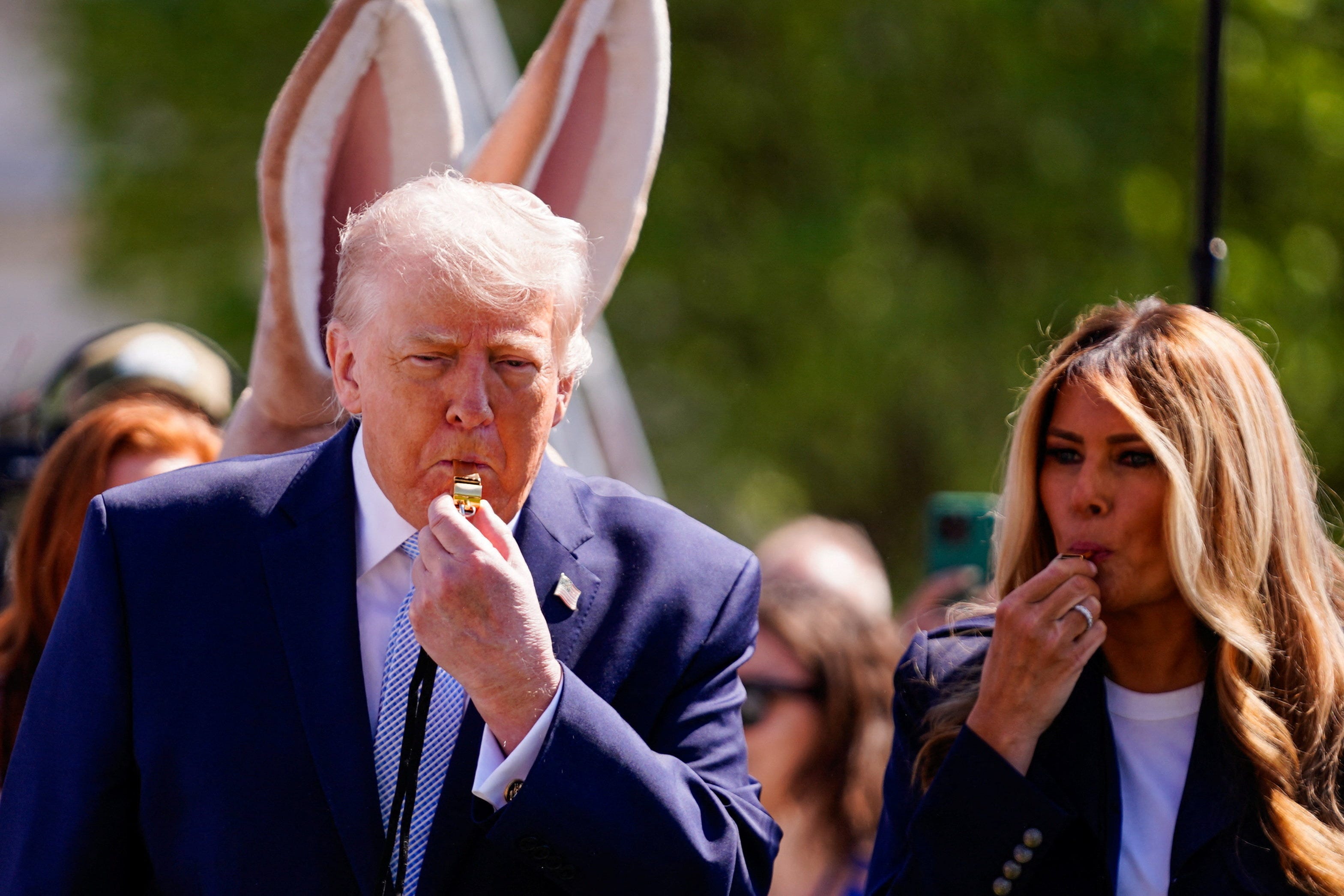
Donald, Melania, and the Terrible, Horrible, No Good, Very Bad Week
Donald Trump's threats against Iran fell through like all his promises, while Melania experienced what's commonly known as the "Streisand Effect"
Good morning, AlterNet America family.
Welcome to the Saturday Wrapup, where I get you the week’s news as I consume my morning caffeine with you. I don’t actually drink coffee, so special shoutout to those of you having energy drinks or tea with me.
To our paying subscribers: thank you. Your support has allowed us to become #2 in Rising News on Substack within our first week. You make this possible. That means everything.
If you’re not yet a paying member, I’m asking you to join us today. Independent media has never mattered more. Support our people-powered movement and upgrade your subscription today.
Trump broke yet another promise this week. It’s a promise he should never have made, but one broken nonetheless. Let’s talk about it.
Under Trump, Nothing Ever Happens – Until It Does
Donald Trump likes the world to think he’s unpredictable. The Iran crisis this week revealed something rather more predictable: a president who makes apocalyptic threats and then backs away from them the moment an off-ramp appears.
On Tuesday, Trump posted on Truth Social that “a whole civilization will die tonight, never to be brought back again,” catastrophic language even by his standards. He had set an 8 p.m. deadline for Iran to reopen the Strait of Hormuz, threatening to bomb civilian power plants and bridges. He and his allies brushed off concerns that such strikes would constitute war crimes. The world braced itself.
Then, with hours to spare, he folded. After Iran agreed to allow passage through the strait, Trump backed down from his threat of wide-scale destruction of Iran’s civilian and military infrastructure. A two-week ceasefire was announced.
The ceasefire itself wasted no time unraveling. The first two days of the truce were marked by major disagreements about what the two sides had actually agreed to, with attacks continuing across the region. By April 9, there was no sign the blockade on the Strait was actually being lifted.
What made this feel familiar is that it wasn’t a one-off. Starting in late March, Trump had repeatedly threatened Iran’s energy grid if the strait were not reopened, but each time, he pushed back the date. On March 23, he postponed his planned attack citing progress in negotiations, and then on March 26, as that deadline approached, he announced yet another delay. Tuesday’s dramatic countdown was at least the third such cycle.
During the 2024 campaign, Trump privately told donors that one of his favorite negotiating tactics was threatening to bomb Beijing or Moscow. The strategy has a certain logic. But deployed repeatedly, it has a corrosive side effect: adversaries begin to learn that the deadline isn’t really a deadline. It’s an opening bid.
Whether that matters depends on what comes next in Iran. But a threat that always comes with an asterisk eventually stops being a threat at all.
Melania Trump Really Wants You to Stop Talking About Her Epstein Connections
In politics, there’s an old rule: don’t repeat the charge. Melania Trump apparently didn’t get the memo.
The most plausible explanation for the first lady’s out-of-the-blue address on the Jeffrey Epstein drama was that she was trying to make it go away. But her stunning on-camera statement from the White House Cross Hall will almost certainly have the opposite effect.
The seemingly out-of-the-blue message came at a moment when her husband’s administration had finally seemed to move past more than a year of Epstein controversy, especially as the Iran war had become all-consuming in Washington. She chose to revive it herself.
The statement was riddled with self-inflicted complications. Melania acknowledged writing a warm 2002 email to Ghislaine Maxwell complimenting her appearance and signing off “Love, Melania,” while insisting this amounted to nothing more than trivial small talk. She also confirmed that her name appears in the latest tranche of Epstein documents, a detail many may not have known before.
Then there’s the question of timing and motive. Some White House officials were stunned by the timing of the remarks, which sparked rumors that the first lady was trying to get out ahead of something. Several of her own aides gathered to watch the statement without knowing what she was going to say beforehand.
Even her husband seemed to distance himself: a person familiar with the matter told CNN that Donald Trump was aware his wife planned to make the statement, but the president told media afterward that he did not “know anything about” it.
To her credit, Melania accomplished something genuinely rare on Thursday: she got people to stop talking about the Iran war. Whether that was the plan is, at this point, anybody’s guess.
Pete Hegseth’s Pentagon Can’t Control What We Publish
A federal judge blocked Pete Hegseth’s Pentagon press restrictions once again this week. The same judge has struck down the rules twice. Hegseth keeps trying anyway.
Judge Paul Friedman concluded his ruling with an unusually sharp rebuke, writing that the case was really about “the attempt by the Secretary of Defense to dictate the information received by the American people, to control the message so that the public hears and sees only what the Secretary and the Trump Administration want them to hear and see.” He also warned that “suppression of political speech is the mark of an autocracy, not a democracy.”
While the credentialed press was being pushed out, Hegseth’s team replaced them with outlets loyal to Trump, including Laura Loomer, Matt Gaetz, and MyPillow CEO Mike Lindell. That is the model: pressure the outlets you can, replace the ones you can’t.
It works on organizations with badges to lose and billionaire owners to answer to. It doesn’t work on us. AlterNet America has no Pentagon credentials to revoke and no oligarch to keep happy, just readers.
And as it turns out, that is enough. Within days of launching, we reached #2 rising news publication on Substack. That is not an accident. That is readers deciding that independent journalism is worth showing up for.
But rankings don’t pay reporters. Momentum doesn’t fund investigations. The media landscape is not doing great right now: 60 Minutes has a new billionaire owner, the FCC is leaning on outlets that won’t play along, and the Washington Post and LA Times take their cues from oligarchs. The journalism that holds power accountable has to be funded by the people who need it.
That is you. To our paid subscribers: thank you. You made that number possible, and you are the reason we can keep going. If you have been reading AlterNet America for free, we are grateful, and we are asking you to take the next step. Please consider becoming a paid subscriber today.
Thanks so much for reading, and we’ll see you tomorrow.
–Ryan Rose
Co-founder & Managing Editor, AlterNet America


👍👍
Donnie does have nice ears. Is he a closet furry?